 Contact Us

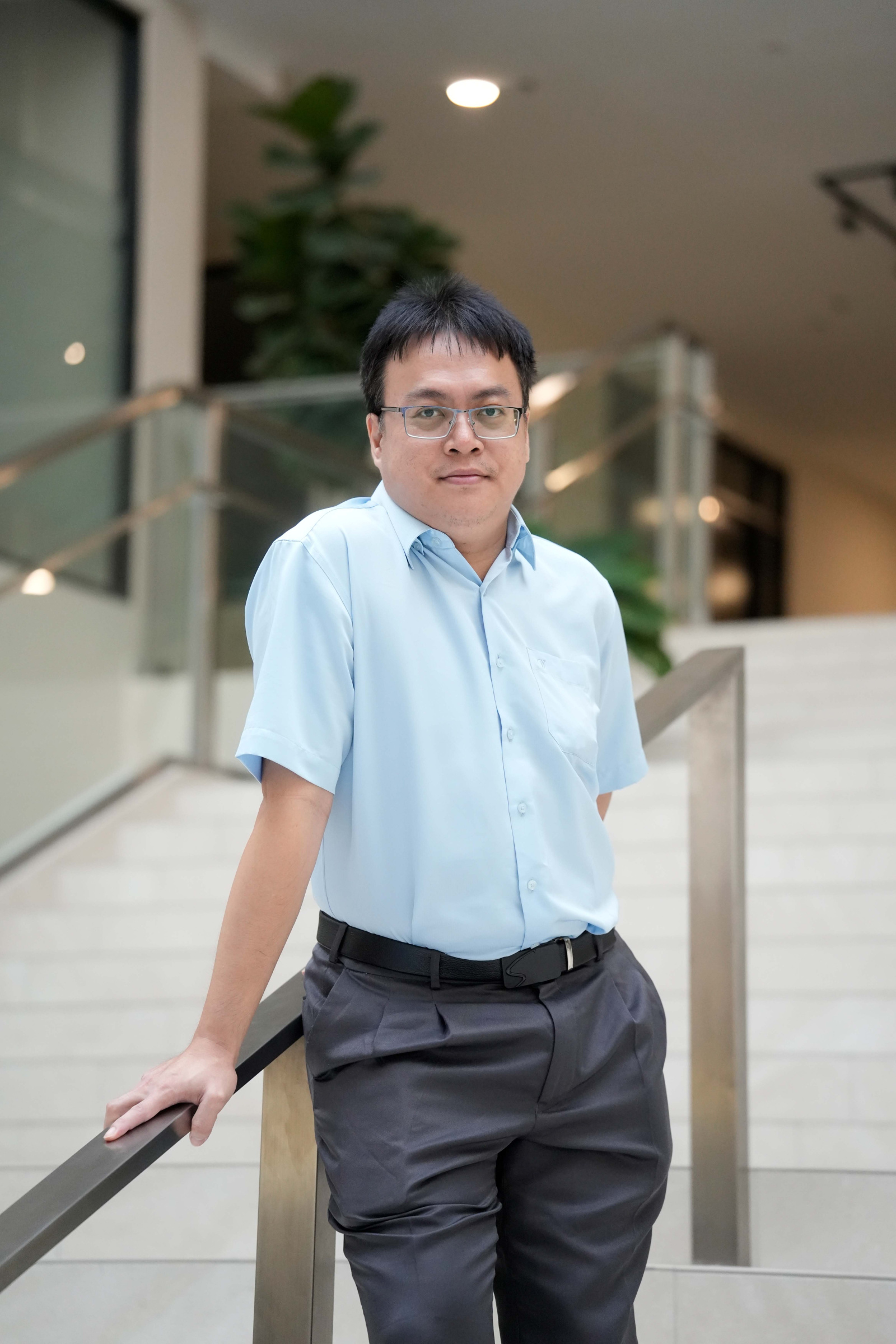
Dr Chu Yih Bing holds a first-class bachelor’s degree in Mechatronics Engineering and PhD in Electrical and Computer System / Chemical Engineering from Monash University. He is an expert qualified in the field of Data Science and AI, Mechatronics, Microelectronics and Analytical Biochemisty.
Dr Chu previously worked as an industrial engineer in automation and biomedical field before joining academics in 2019. To date, he has served as keynote speaker in innovation in teaching symposium, guests journal reviewer, conference technical committee member and associate member of national and international engineering associations which include IEEE, Energy Institute and MYSET. He has secured grant and become an active project member under FRGS and MJTA for research related to biomedical engineering and carbon capture and utilization system.
Dr Chu possessed extensive experience in the field of computer engineering and AI. He has designed the curriculum and delivered courses related to Industry 4.0 such as AI, Big Data, Cybersecurity, Blockchain, Human Computer Interaction, Machine Vision and so on. He has published numerous conference and journal articles in the field of Industry 4.0, Virtual/Augmented Reality, Artificial Intelligence, Cybersecurity, Microelectronics and Biomedical Engineering. His current research interest includes Quantum Computing, Machine Learning, Cybersecurity, BioMEMS/NEMS, Robotics, Renewable Energy and Translational Medicine.
Dr Chu’s research endeavours to develop and investigate computational algorithm and advanced mechatronics system to aid data driven decision and perform collaborative task with human. He has carried out comprehensive studies in machine learning technologies accompanied with the corresponding applications in diverse field such as cybersecurity, robotics, human computer interaction and production engineering.
Recently, he is conducting research in devising AI enabled drone to aid disabled in performing daily activities supported with seeding grant from Petronas.
Journal
1. Yong Cai Zhang, Y. B. Chu, Yonghua Huang and Zhaowen Li (2025) Feature Selection for Heterogeneous Data Based on Weighted KNN-neighborhood Rough Set Model and Self Information, International Journal of Machine Learning and Cybernetics, 16, 8907–8932. (Springer, ISI – Q3).
2. Last Author: Y. B. Chu (2025) The ensemble of self-information-based feature selection for heterogeneous data via k-nearest neighborhood rough set model, The Journal of Supercomputing, 81(6), 780. (Springer, ISI – Q2).
3. Ahmed Rafat Elkilany and Y.B. Chu (2025) Elucidation on the Performance of Various Machine Learning Models for Real-Time Malware Detection, Malware Classification and Network Packet Screening. Machine Learning for Computational Science and Engineering, 1, 9. (Springer).
4. Y.B. Chu (2024) Performance analysis of shear horizontal one port surface acoustic wave (SAW) resonator for optimal liquid sensing based on finite element method. E-Prime - Advances in Electrical Engineering, Electronics and Energy, 10, 100799. (Elsevier, Scopus – Q2)
5. Y.B. Chu, Y.C. Zhang and H.Y. Wong (2024) Evaluating System Usability and Acceptance of a Quiz Based Augmented Reality Interaction for Learning Solutions of Electrical Motor. International Journal of Information and Education Technology, 14(9):1299-1305. (Scopus – Q2).
6. Y.B. Chu et. al. (2023) Credit Card Fraud Detection On Original European Credit Card Holder Dataset using Ensemble Machine Learning Technique. Journal of Cyber Security, 5,33-46. (Tech Science Press)
7. Y. B. Chu (2022) A Mobile Augmented Reality System to Conduct Electrical Machines Laboratory For Undergraduate Engineering Students During the COVID Pandemic. Education and Information Technologies, 27: 8519-8532. (Springer Nature, ISI/Scopus – Q1)
8. Y. B. Chu and YongCai Zhang (2022) Design of SAW Based MEMS Device for Self-powered Electronics Using Artificial Intelligence Technique. Energy Reports, 8(10):90-97. (Elsevier, ISI/Scopus – Q2)
9. Q.Y. Wong and Y.B. Chu (2021) A Mobile Production Monitoring System Based on Internet of Thing (IoT) and Random Forest Classification. International Journal of Electrical and Electronic Engineering & Telecommunications 10:243-250. (Warsaw University of Technology, Scopus – Q3)
10. Y.B. Chu et. al. (2014) Microfabrication of Surface Acoustic Wave Device Based on UV LED photolithography technique. Microelectronics Engineering. (Elsevier, ISI/Scopus – Q2)
Book Series/Chapters/Proceedings
1. Y.B. Chu and J.S.Y. Gan (2024) Detection and Subclassification of Severity Levels of Crime Activities with Machine Learning, 1253 Lecture Notes in Electrical Engineering, pp. 3–10 (Springer Nature, Scopus – Q4)
2. Last Author: Y.B. Chu (2024) Integration of Big Data and Machine Learning Solutions as Preventive Maintenance Strategies to Improve Manufacturing Productivity, 1253 Lecture Notes in Electrical Engineering, pp. 11–18 (Springer Nature, Scopus – Q4)
3. Y. Zhang, Y.B. Chu and T. Jiang (2024) Safety Zone and Its Utilization in Collision Avoidance Control of Industrial Robot, 2024, Communications in Computer and Information Science, 2146 CCIS, pp. 231–246 (Springer Nature, Scopus – Q3)
4. 5th author : Y.B. Chu (2023) SERS Analysis for Single-Molecule Detection of Disease Biomarkers in Single Biomolecule Detection and Analysis, 2022, pp.275-304, CRC Press (Taylor and Francis, Scopus)
5. 3rd author : Y.B. Chu (2022) Investigating Evoked Action Potential in Human Optic Nerves using MRI in 7th IEEE-EMBS Conference on Biomedical Engineering and Sciences, IECBES 2022 – Proceedings, 2022, pp. 415–419 (IEEE, CPCI/Scopus)
6. Y.B. Chu and C.W. Chang (2021) A Mobile Augmented Reality Interface On Additive Manufacturing in Advances in Electrical and Electronic Engineering and Computer Science, Lecture Notes In Electrical Engineering 741:1-12 (Springer Nature, Scopus – Q3)
7. Y.B. Chu and W.K. Yap (2021) Raspberry Pi based Wireless Interface System For Automated Microfabrication in The Context of Industry 4.0 in Advances in Electrical and Electronic Engineering and Computer Science, Lecture Notes In Electrical Engineering 741:117-123 (Springer Nature, Scopus – Q3)
- Theory of Computing
- Machine Learning Technologies
- Computer Systems II